Münster is characterized by research, academia, and the city’s urban qualities. The BLB NRW, the University of Münster and University of Applied Sciences Münster, the Student Services Organization, and the city aim to integrate these areas even more closely through urban planning in the future. The partners reached an important milestone today with the signing of the jointly developed “NWZplus Urban Planning Structural Concept.” In doing so, they are reaffirming a shared vision for the future-oriented development of the approximately 250,000-square-meter Natural Sciences Center (NWZ) near the city center.
Several years ago, it had already been agreed to further develop the city’s science-oriented districts into “urban knowledge districts.” “The fact that we drafted this document together, transcending institutional boundaries, is unique in this form and something special. “From the very beginning, the collaboration was characterized by a high degree of trust, mutual understanding, and a shared commitment to finding good solutions,” says Markus Vieth, technical director of the Münster branch of the NRW Construction and Real Estate Management Agency, describing the process.
From the very beginning, the partners agreed that the concept should focus on science, mixed-use development, student accomodation, mobility, sustainability, open space, climate resilience, and an enhanced quality of life.
“With our joint structural concept, the monofunctional Natural Sciences Center can become a vibrant part of Münster. Together, we must seize this opportunity to further strengthen Münster as a hub for science while also bringing more urban life to the neighborhood. This also includes the development toward a green, water-sensitive, and climate-resilient knowledge district,” says Mayor Tilman Fuchs, explaining the concept of the urban knowledge district.
Münster’s City Planning Director, Robin Denstorff, is also convinced of the structural concept: “The structural concept addresses all the key issues for contemporary urban planning and future-oriented neighborhood development: neighborhood revitalization and mixed-use development, the creation of livable spaces and neighborhood identities, smart mobility solutions, strengthening ecological qualities in line with the ‘sponge city’ concept, and the further development of green infrastructure. On this basis, all participating partners can contribute to the multifunctional further development of the Natural Sciences Center.”
From a university campus to a vibrant neighborhood
The NWZplus is bounded on the east by Orléans-Ring, on the north by Henriette-Son-Straße and Mendelstraße, on the west by Busso-Peus-Straße, and on the south by Von-Esmarch-Straße. So far, the area has primarily been a typical university campus and still lacks urban infrastructure. Buildings from the 1960s and 1970s stand alongside modern research facilities, while multi-lane roads and large traffic-light-controlled intersections define the surroundings. The wide paths between the institutes are paved with asphalt or cobblestones.
The structural concept is based on a jointly developed plan that was created through a workshop-style process with the support of an external planning firm. All project partners cooperatively contributed their diverse needs and professional perspectives to the process.
The basis for the urban redevelopment of the university grounds was, first and foremost, to take into account the existing buildings as well as those currently in the planning or construction phases. Subsequently, the space requirements were determined and reorganized into building complexes on the site. “It is particularly positive that the concept establishes a common direction while also leaving room for future adjustments. This gives us the flexibility we need as a university for our planning,” emphasizes University Rector Prof. Dr. Susanne Menzel-Riedl.
Mobilitätskonzept schafft Verbindung
The signed structural plan now calls for a low-traffic neighborhood with a well-thought-out mobility concept. Parking spaces are to be reduced and consolidated into mobility stations on the outskirts of the area. The plan aims to redesign Corrensstraße—currently an oversized traffic corridor—into a key route for cyclists, pedestrians, and public transportation. This section of Münster’s “Science Boulevard” thus runs through the neighborhood from north to south. From east to west, however, the so-called “Wissensstrahl” runs along Wilhelm-Klemm-Straße and Röntgenstraße. “Science Boulevard” and the “Knowledge Beam” thus form two central axes within the neighborhood, connecting various areas—from the city center to Gievenbeck. This also represents a real opportunity for the University of Applied Sciences Münster.
“With the NWZplus urban development plan, we are positioning our university campuses in Münster for the future: Development opportunities will strengthen the University of Applied Sciences Center, and with the ‘Science Boulevard,’ we are connecting the Hüffer Campus, the University of Applied Sciences Center, and the Leonardo Campus—working together with our partners to create a vibrant, sustainably connected, virtually car-free knowledge district —a step that, in the best spirit of neighborliness, ‘makes us look forward to tomorrow,’” emphasizes Prof. Dr. Frank Dellmann, President of the University of Applied Sciences Münster.
The new traffic light system, which allows pedestrians to cross the Orleáns-Ring at the intersection with Domagkstraße, is already contributing to the mobility concept.
More Green Space, Social Interaction, and Student Life
The goal of the urban development plan is to create more space for green areas and open spaces, as well as attractive gathering places. These spaces offer ecological benefits by helping to improve the microclimate and promote biodiversity, or by serving as stormwater retention and infiltration areas. At the same time, they provide space for social interaction, leisure, sports, dining, and recreation. Dr. Christoph Holtwisch, Executive Director of the Münster Student Services Organization, also welcomes this development: “The revitalization of the Natural Sciences Center will be driven by the students. As the Studierendenwerk, we are therefore pleased that the NWZplus structural concept also takes into account new dining hall concepts and student accomodation in the neighborhood.”
A Shared Vision for the Future
By signing the final document, the partners have laid out a common roadmap to make Münster and its knowledge districts more attractive. “To achieve this, it was important to bring everyone to the table,” emphasizes Markus Vieth of BLB NRW, highlighting the forward-looking nature of the plan: “Nothing is set in stone yet with our signed concept. It is a declaration of intent for the forward-looking and future-oriented urban planning of an urban knowledge district, which has already been coordinated with all partners in advance. This allows us to create a solid foundation for implementing future needs more quickly.”
A Quarter-Century of BLB NRW
25 Years of the North Rhine-Westphalia State Building and Real Estate Management Agency (BLB NRW): With approximately 4,000 buildings and a leasable area of about 10.3 million square meters, the BLB NRW owns and leases nearly all of the buildings in the State of North Rhine-Westphalia and manages one of the largest real estate portfolios in Europe. Its services include, among other things, the development and planning, construction and modernization, as well as the management and sale of technically and architecturally highly complex properties. In addition, as part of the Federal Construction Program, the BLB NRW plans and carries out the civil and military construction projects of the Federal Republic of Germany in North Rhine-Westphalia. BLB NRW employs more than 3,100 staff members at eight locations. For more information, visit www.blb.nrw.de
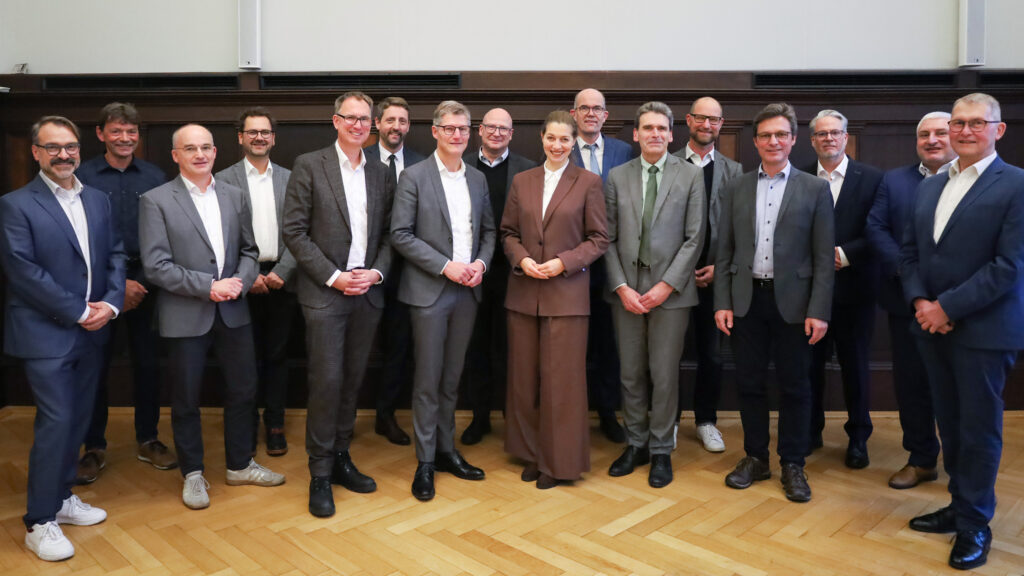
Pictured (in order): Marcel Fischer (BLB NRW), Rainer Leuders (BLB NRW), Gregor Kleinhans (BLB NRW), Dr. Christoph Holtwisch (Studierendenwerk Münster), Robin Denstorff (City of Münster), Tilman Fuchs (Mayor), Matthias Schwarte (University), Prof. Dr. Susanne Menzel-Riedl (University), Guido Brebaum (University of Applied Sciences Münster), Prof. Dr. Frank Dellmann (University of Applied Sciences Münster), Volker Ruff (Münster Technology Promotion), Matthias Dieler (University of Applied Sciences Münster), Torsten Maag (University), Dr. Marco Trienes (Economic Development), Markus Vieth (BLB NRW).