


Meetings and overnight stays
Facts & Figures
|
Anzahl Zimmer |
Anzahl belegte Zimmer |
Anzahl Tagungsräume |
Umsatz Frühstück |
Anzahl Tagungen |
|
|---|---|---|---|---|---|
| Agora: am Aasee | 25 | 5.269 | 5 | 60.302 | 549 |
| SeeZeit | 23 | 2.726 | 1 | 71.975 | 32 |
| Gästehaus | 13 | 4.477 |
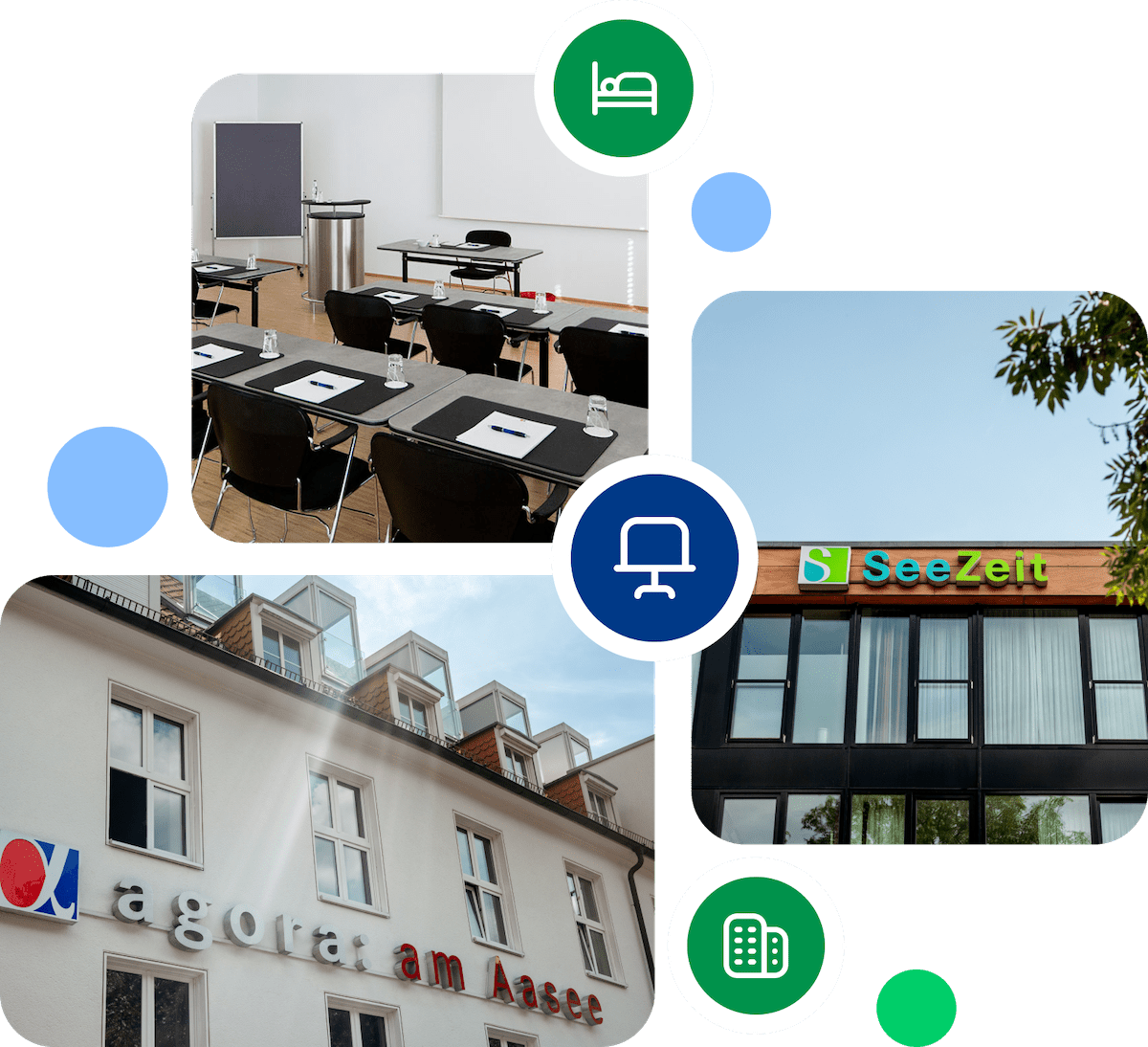

Spend the night with a view of the Aasee - over 20 years of hotel operations at Studierendenwerk Münster
Studierendenwerk Münster has been successfully running the hotel “agora: am Aasee” for over two decades – in the immediate vicinity of the city center and directly on the Aasee. Hotel manager Ulrike Hammen, who has been part of the team for over 21 years, looks back on the beginnings and the developments that have shaped the hotel business to this day.
From guest house to established hotel
Hotel agora opened its doors for the first time in 2003 – initially not as a traditional hotel, but as a guest house. “The rooms were mainly intended for professors at the University of Münster who were looking for a simple place to stay and wanted to cater for themselves with their own kitchen,” reports Ulrike Hammen – an employee from the very beginning. After working in the Swabian Alb and Münster, she started working at the Studierendenwerk six months before the opening. “The building at Bismarckallee 5 used to house student accommodation,” she recalls. “When I arrived, the building was still being renovated and I asked myself: Where is the guest house? Everything was still a huge building site! The seminar center was already up and running, but it was still very small and on the side.”
Read more
Continuous expansion and increasing demand
As the guest house became increasingly well-known, it was also opened to private visitors and business travelers. Together with two colleagues, Ulrike Hammen initially took on tasks relating to room management, reservations and looking after the breakfast room. “It was only half the size it is today,” she explains, “We only had 18 seats. Sometimes a lot more people came, so we had to ask guests to wait.”
Demand grew quickly – as did the number of regular guests. “For example, footballers from Preußen Münster often came to us, who appreciated the beautiful and central location. But we’ve also had Cem Özdemir as a guest. That’s always exciting, of course.” As the number of guests grew, so did the team. The processes became more professional and adapted to normal hotel operations. “We hired our own cleaning staff and each of us was given a fixed area of responsibility. For example, I was responsible for the breakfast room before I went on parental leave for 1.5 years in 2012.”
Expansion of the offer: the SeeZeit
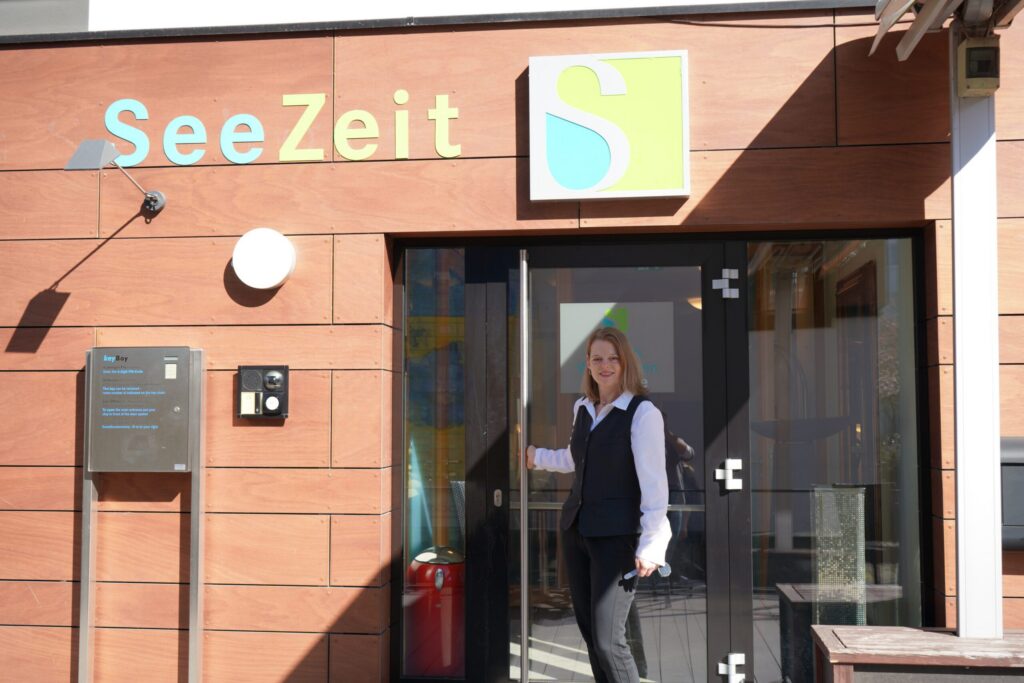
Due to the successful operation of the agora and in particular the increasing demand in the conference sector, a residential complex at Bismarckallee 47 in need of renovation was converted into a second hotel in 2008. In addition to new living space for students, the SeeZeit Hotel was created – also with a direct view of the Aasee. SeeZeit also quickly established itself on the market and has enjoyed very good occupancy rates ever since. The clientele of both hotels is mixed. At the weekends, vacation guests tend to come to explore Münster and the surrounding area, while during the week it is mostly business people and conference guests who stay in the rooms. “The view of the Aasee here is unbeatable. People feel like they’re on vacation here!” emphasizes Ulrike Hammen.

Challenges and opportunities in the pandemic
The hotel and seminar center ran smoothly until 2020. However, with the first coronavirus lockdown, the operation of both facilities had to be temporarily restricted. Only business people with proof of vaccination were allowed to stay overnight. “It was a shock for all of us at first,” recalls the hotel employee. “Nobody really knew what was happening.” Almost all employees were then given partial or full leave of absence over a longer period of time. For a while, only the hotel management and two trainees were still on site. “I was very grateful that I still got my full salary. But of course I missed my work – it felt like the lockdown would never end,” says Ulrike Hammen.
The pandemic-related closure period was used to extensively renovate Hotel agora and bring it up to the latest technical standards. The air conditioning systems urgently needed for the hot summers were also installed as part of this. “The worn-out rooms didn’t suit the beautiful location either,” says Hammen with a smile. New modern furniture and carpets now ensure a contemporary and inviting ambience. Important steps have also been taken in the area of digitalization: “Everything that goes digital, goes digital. And if it all works, that’s great, of course. We have been working with the Key Boy for some time now. It allows us to hand over keys to guests without being on site. That goes down really well.” Despite increasing automation, one thing is certain for Hammen: “Direct contact with guests is very important to me.”
A profession with prospects
In addition to the contact with guests, Ulrike Hammen particularly appreciates the collegial atmosphere: “I love having people around me. We also have a nice team here. The core team has been working together for many years, even if there are of course changes. We also go out to eat together, for example. And what else speaks for the job: the family-friendly working hours, which is anything but a given in my job.”
The hotel business is not only a success story for Ulrike Hammen. After more than 20 years, Studierendenwerk Münster can also look back on the successful development of its two hotel locations. The consistently high occupancy rate, the dedicated team and the consistent further development – both structurally and digitally – contribute significantly to the fact that guests feel completely comfortable and well looked after at agora and SeeZeit today.


