
Student Financing

Student Finance Department relies on electronic file

Aljosha Kröger, Head of the Student Finance Department, explains the advantages.

Since 2020, students have been able to apply for their educational funding online via the nationwide “BAföG Digital” portal. Despite this, clerks in the student finance department still had to laboriously print out applications in order to process them. The electronic file should remedy this situation at the beginning of 2024. Aljosha Kröger, new Head of the Student Finance Department at Studierendenwerk and previously Deputy Head for three years, explains the advantages of this innovation.

Mr. Kröger, you joined us in September 2023 as Head of the Student Finance department. How have you settled in?

It wasn’t that difficult, as I’ve been working here for some time. Of course, it was challenging at the beginning because I didn’t have a deputy. But it has to be said that my colleagues made it very easy for me. I received a lot of support from the department and was also well received in my new role.

You already focused on administrative and social law during your studies. What excites you about this area?

The really interesting thing about law is that you deal with rules and also learn to regulate things. I think that it is particularly important in the area of social and administrative law, where the state faces the citizen, that you make sure that you act evenly and sensibly.
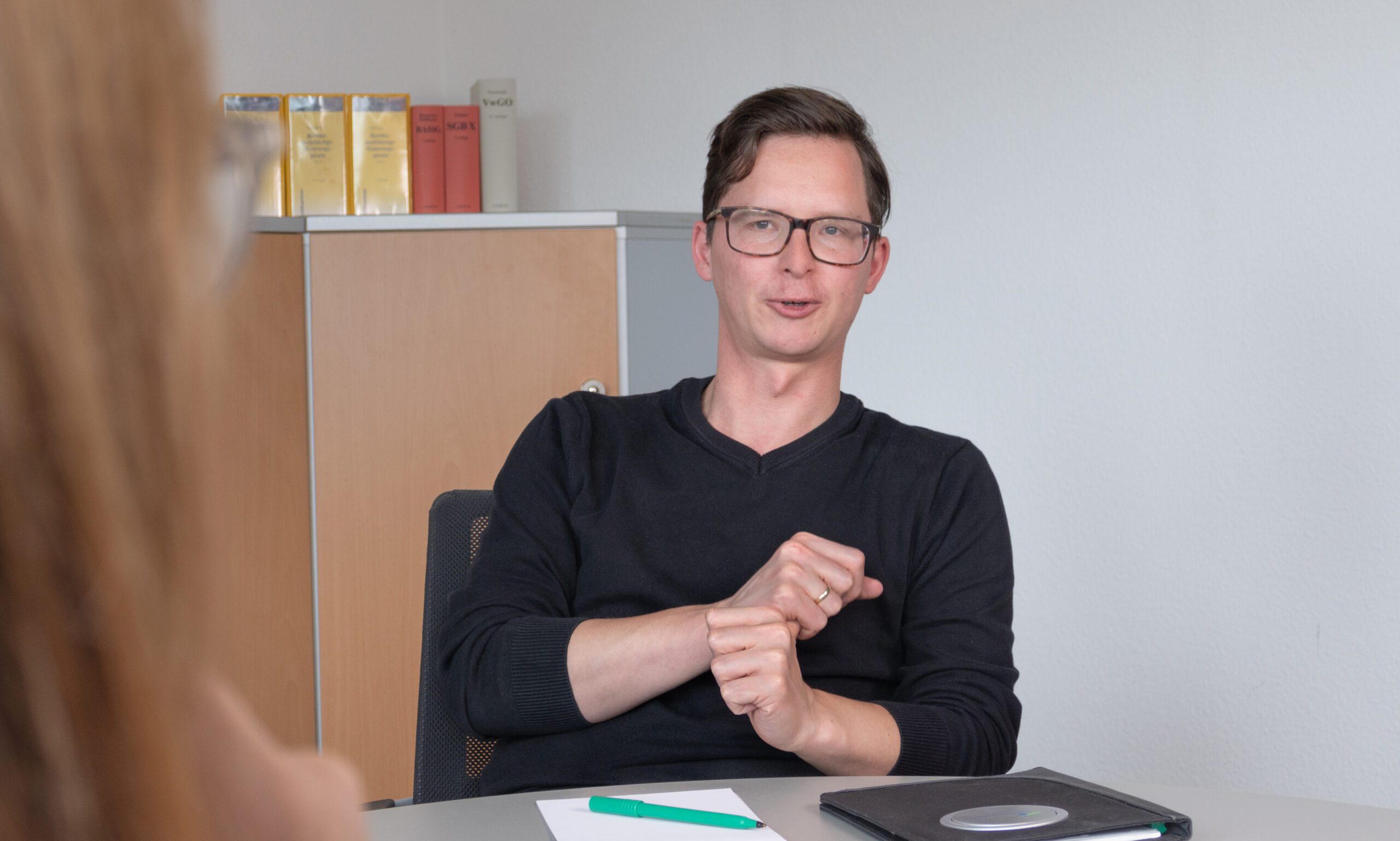
A man with glasses and a black sweater sits at a desk and gestures with his hands during a conversation. On the table is a notepad with a green pen and a closed laptop. A blurred person is standing opposite him.

Then the decision to start at the Studierendenwerk was exactly right for you.

I think so too. I was already familiar with Studierendenwerk Münster before I started working here. I studied in Münster and received BAföG here myself and I think I’m now in a position where I can make a relatively big difference, which I find very interesting.

Making a difference is a good keyword. One of your projects is the integration of “BAföG Digital”. What have you been able to achieve in the time you’ve been here?

It was a little difficult at the beginning because the portal was launched at short notice over the weekend. The particular challenge was that we were able to receive applications digitally, but not process them digitally. We had to adapt our work processes as we had to print out the applications ourselves from then on. We then set about developing the electronic file. The introduction of “BAföG Digital” was also an incentive to implement this quickly instead of waiting any longer.

To what extent should or can the digital file speed up the editing process?

I would say that we are already processing applications relatively quickly. We usually manage to process complete applications within 2-4 weeks. Unfortunately, it just takes a long time until the application is complete. But I think it’s less about faster processing and more about easier processing. If the paper files are with one person, no one else can work with them during this time. Several people can view a digital file at the same time and also provide the relevant information. This is also a great efficiency gain, especially for the central info point or for consultation hours. The keyword search within the digital file also makes it easier to find specific documents. A file can have up to 250 to 300 pages and if you are looking for a specific document and don’t know when it was received, it can be difficult.

A man with glasses and a black sweater sits at a desk and gestures with his hands during a conversation. On the table is a notepad with a green pen and a closed laptop. A blurred person is standing opposite him.

Dann war die Entscheidung, im Studierendenwerk anzufangen, für Sie ja genau richtig.

Das denke ich auch. Das Studierendenwerk Münster kannte ich schon vor meiner Anstellung hier. Ich habe in Münster studiert und hier selbst BAföG bezogen und denke, ich bin jetzt in einer Position, in der ich relativ viel bewegen kann, das finde ich sehr interessant.

Etwas bewegen ist ein gutes Stichwort. Eins Ihrer Projekte ist die Integration von „BAföG Digital”. Was konnten Sie in der Zeit, in der Sie hier sind, erreichen?

Am Anfang war es etwas schwierig, weil das Portal quasi kurzfristig übers Wochenende gestartet ist. Die besondere Herausforderung war dann, dass wir zwar die Anträge digital entgegennehmen, aber nicht digital bearbeiten konnten. Wir mussten unsere Arbeitsabläufe anpassen, da wir die Anträge ab da selbst ausdrucken mussten. Dann haben wir uns auf den Weg gemacht, die elektronische Akte auszuarbeiten. Die Einführung von „BAföG Digital” war auch ein Ansporn, das schnell durchzuziehen statt weiter abzuwarten.

Inwiefern soll oder kann die digitale Akte den Prozess der Bearbeitung beschleunigen?

Ich würde schon behaupten, dass wir bereits relativ schnell in der Bearbeitung sind. Wir schaffen es in der Regel, innerhalb von 2-4 Wochen, vollständige Anträge zu bearbeiten. Leider dauert es nur sehr lange, bis der Antrag vollständig ist. Aber ich denke, es geht weniger um schnellere als um einfachere Bearbeitung. Wenn die Papierakten bei einer Person liegen, kann in dieser Zeit kein anderer damit arbeiten. Eine digitale Akte können mehrere Leute gleichzeitig einsehen und auch die entsprechenden Auskünfte erteilen. Das ist auch gerade für den zentralen Infopoint oder für die Sprechstunde ein großer Effizienzgewinn. Die Schlagwortesuche innerhalb der digitalen Akte macht es auch leichter, bestimmte Unterlagen zu finden. So eine Akte hat bis zu 250 bis 300 Seiten und wenn man dann ein bestimmtes Dokument sucht und nicht weiß, wann es eingegangen ist, dann wird’s schon schwierig.

Das Land ist ja auch grade dabei eine eigene digitale Akte zu entwickeln. Wird dann unsere im Nachgang vielleicht überflüssig?

Im Endeffekt ist es so, dass ein einheitliches Bearbeitungsformat mit PDF existiert, auf dem alle digitalen Akten aufbauen und egal, wie die Benutzeroberfläche ist, würde man die Daten übertragen können.

Info icon
In 2023, the proportion of sponsored students was 17.47%.
A person at a table fills out a German application form entitled "Antrag auf Ausbildungsförderung" ("Application for educational support") with a pen. The BAföG logo is shown at the top of the form.

The country is also in the process of developing its own digital file. Will ours then perhaps become superfluous?

The bottom line is that there is a standardized processing format with PDF on which all digital files are based and no matter what the user interface is like, the data can be transferred.

Where do you see the challenges in the area of BAföG in the coming years?

You simply have to make sure that the process is not made any more complicated. The work, the bureaucracy, which is largely incurred, is necessary because BAföG is a social benefit that is linked to need and this must of course be checked. Elsewhere, however, you can also see that BAföG still assumes that studies are still structured as in the diploma, which would have to be adjusted. Hardly anyone manages to complete their studies in the standard period of study. It would be good if the funding period was no longer based on this, but on the usual duration of studies. Although BAföG is constantly being changed, it is usually only minor adjustments that are made, but the administrative burden often increases precisely because of this. We need to look at how to simplify the forms and the application process. However, politicians need to keep this in mind, as there is relatively little we can do – apart from making suggestions via the official channels, of course. Ultimately, we have to ensure that our structures are set up for the future and that our work processes are designed in such a way that we can work efficiently. Much of what still made sense on paper has actually become obsolete due to digitalization.

And finally: If you had a magic wand and could change anything in the BAföG area, what would it be?

With the “BAföG Digital” platform, we already have a central application office, but we need a digital interface that can also be used to communicate with students. We still write letters at the moment. But it would be great if we could communicate via the application portal in the future. This would allow us to significantly improve our service quality.

62 million €
BAFöG was paid out
10.094
Students were funded in 2024
The average funding amount was
512 €
190.000 €
The BAföG rate of the Studierendenwerk Münster is as follows

New appointment booking software

The new appointment scheduling software TEVIS has been successfully introduced at Studierendenwerk Münster. Since May, students have been able to book appointments at the BAföG office, general social counseling, social counseling for students with children and Student Accomodation digitally from the comfort of their own home. “The new online appointment booking system means we can avoid long queues in the corridors,” explains Oliver Valerius, Head of the Department of Social Affairs. “At the request of students, we also offer open telephone consultation hours that can be used flexibly.” The software was introduced in collaboration with the Studierendenwerk’s IT department.

The video shows how the new appointment booking software works. Have fun!

Search
Easy language

The BAföG office helps students with money.

Many students need this money to live on.

You can submit the application online.

You can do this on this page: BAföG-Digital.

The office used to print all applications on paper.

Now there is the digital file on the computer.

This makes work easier for employees.

This enables them to answer questions more quickly.

62 million euros were paid out in one year.

Over 10 thousand students have received money.

A student receives an average of 512 euros per month.

There is also a new program for appointments.

The program is called TEVIS.

You can book your appointment online.

Then you won’t have to wait much longer.

You can book appointments for the BAföG office.

This also works for Counselling or Accomodation.

Search
Easy language

The BAföG office helps students with money.

Many students need this money to live on.

You can submit the application online.

You can do this on this page: BAföG-Digital.

The office used to print all applications on paper.

Now there is the digital file on the computer.

This makes work easier for employees.

This enables them to answer questions more quickly.

62 million euros were paid out in one year.

Over 10 thousand students have received money.

A student receives an average of 512 euros per month.

There is also a new program for appointments.

The program is called TEVIS.

You can book your appointment online.

Then you won’t have to wait much longer.

You can book appointments for the BAföG office.

This also works for Counselling or Accomodation.