Student Financing

Cash benefits from the state

Benefits under the BAföG (Federal Training Assistance Act) are cash benefits provided by the state to enable financially disadvantaged students to study. Provided the eligibility requirements are met, half of the benefits are granted as an interest-free loan and half as a grant.

2.572
Initial applications
(previous year 3,489)
5.661
Repeat applications
(previous year 6,802)
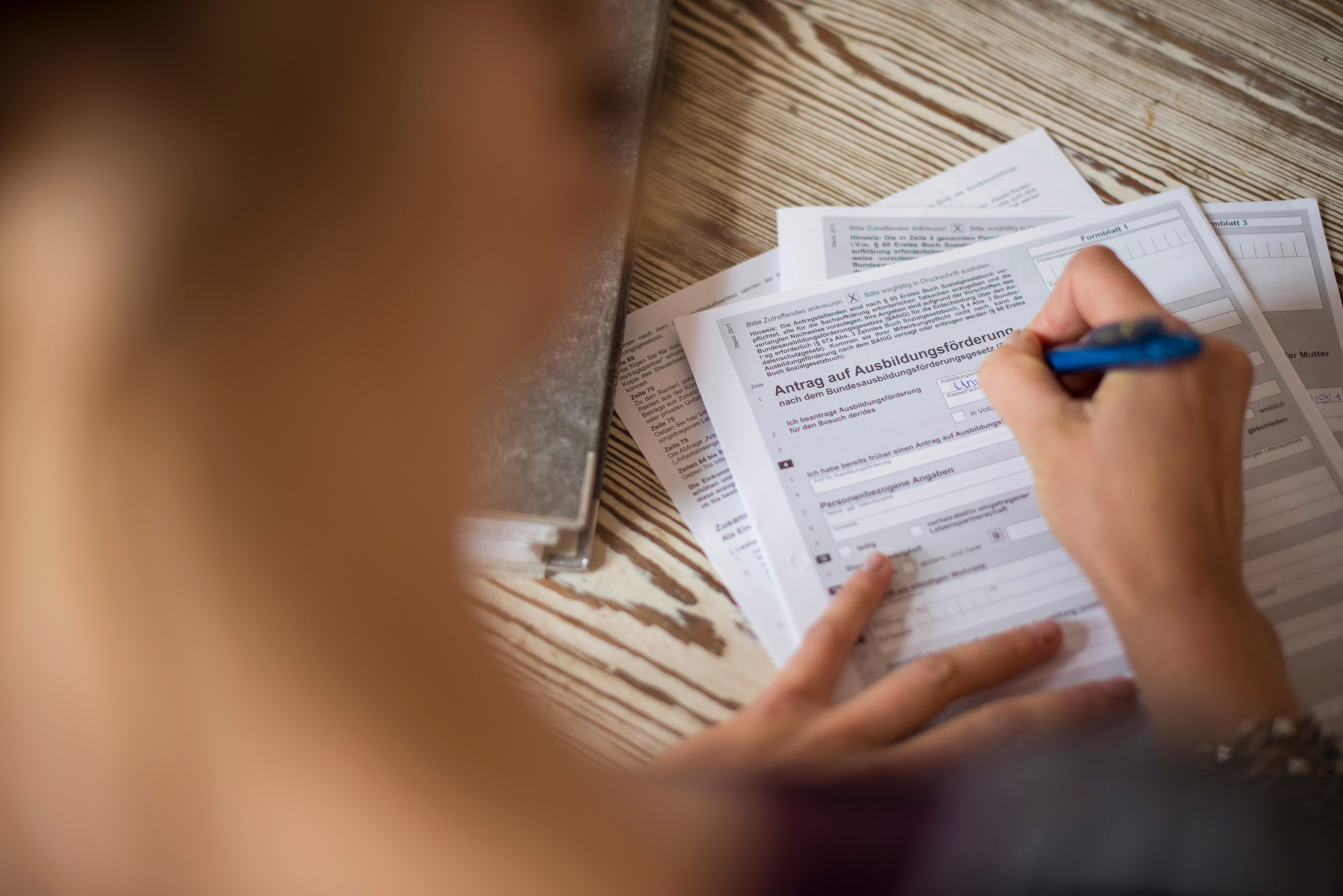
A person at a table fills out a German application form entitled "Antrag auf Ausbildungsförderung" ("Application for educational support") with a pen. The BAföG logo is shown at the top of the form.

The Studierendenwerk Münster is responsible for the implementation of the Federal Training Assistance Act (BAföG) and for the corresponding support of students at the following universities:

  1. Westphalian Wilhelms University
  2. Münster University of Applied Sciences
  3. Catholic University of Applied Sciences NRW (KatHO NRW)
  4. Münster University of Music / FB 15 of the Westf. Wilhelms University
  5. Art Academy Münster
  6. Franciscan and Capuchin School of Philosophy and Theology
  7. EU/FH, Rheine

In addition to Counselling students regarding the eligibility of their education for funding and processing incoming applications for funding from students, this responsibility essentially includes the following tasks:

  • Civil law enforcement of maintenance claims before the family courts
  • Conducting appeal proceedings as the appeal authority
  • Conducting administrative dispute proceedings before the Münster Administrative Court
  • Decision on changes to claims in accordance with Section 59 of the State Budget Code (LHO) – deferrals, write-offs or waivers of reimbursement claims
  • Implementation of fine proceedings
  • Implementation of enforcement measures

The Cologne district government is responsible for the technical supervision of enforcement in accordance with the law.

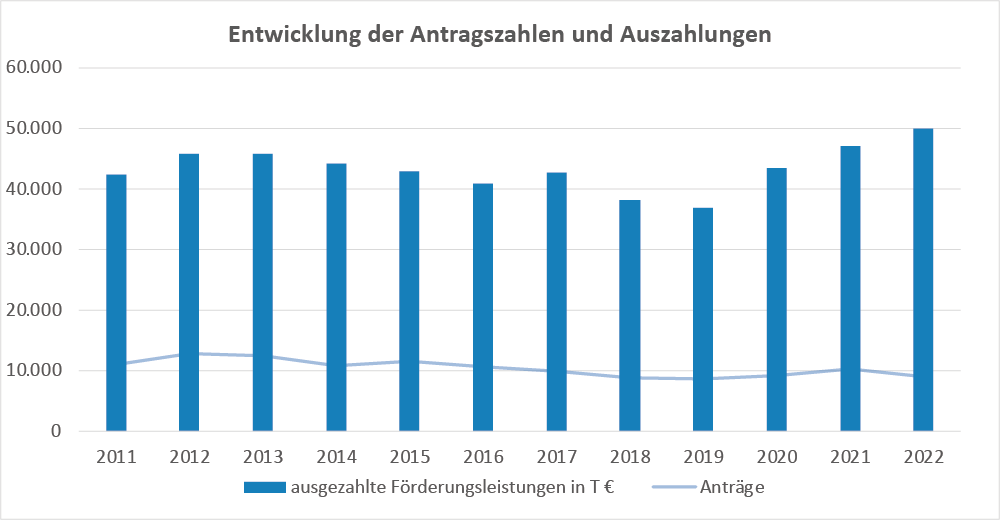
By the relevant submission deadline, 2,572 (previous year: 3,489) initial applications and 5,661 repeat applications (previous year: 6,802) had been processed and decided.
A total of 9,056 applications (previous year: 10,291) were therefore decided (including the 10% to be added for applications decided manually). This represents a reduction of 1,235 applications compared to the previous year.
The total amount of services made payable via IT-NRW amounted to € 49,914.6 thousand in 2022 (previous year: € 46,969.9 thousand).
Despite the significantly lower number of approved applications, the amount of funding paid out increased by € 2,944.6 thousand compared to the previous year (previous year: € 3,495.7 thousand).
The number of people receiving funding in the reporting period even fell slightly by 70, from 9,465 in 2021 to 9,395 in 2022.
The following table and charts provide an overview of the number of applications processed and the funding paid out in the years 2010 to 2022.

Jahr Erstanträge Wiederholungsanträge Gesamt ausgezahlte Förderungsleistungen in T€
2010 4.604 6.285 10.889 39.217,2
2011 4.720 6.196 10.916 42.353,2
2012 5.570 7.143 12.713 45.750,6
2013 5.512 6.889 12.401 45.697,3
2014 4.381 6.441 10.822 44.163,9
2015 5.119 6.431 11.550 42.785,9
2016 4.637 5.967 10.604 40.832,6
2017 4.352 5.623 9.975 42.691,8
2018 3.789 5.052 8.841 38.086,0
2019 3.725 4.857 8.582 36.876,7
2020 3.270 5.904 9.174 43.474,2
2021 3.489 6.802 10.291 46.969,9
2022 2.572 5.661 9.056 49.914,6

In 2022, 390 appeals were lodged (previous year: 393). Only 37 cases were remedied (previous year: 38), a notice of objection has been issued in 45 cases to date (previous year: 76 in total) and 61 are still outstanding (three from the previous year). The remaining appeals were settled by other means (e.g. by withdrawal or reinterpretation).
In the same period, twelve proceedings were initiated in the administrative jurisdiction, all before the Administrative Court. Two of the proceedings before the administrative court have already been concluded – one was successful and the other was settled. The remaining proceedings are still ongoing.
A total of five proceedings were commenced before the civil courts in 2022, four of them at the district courts and one at the higher regional court. One case was successful, one was settled, two cases were lost and one is still pending.

In addition to BAföG, there is also the possibility of funding via the Darlehenskasse der Studierendenwerke im Land Nordrhein-Westfalen e.V. (DAKA). This has been providing funds to the Studierendenwerke since it was founded in 1953. Students who need financial aid can apply for an interest-free student loan with a maximum amount of €12,000 from the Darlehenskasse der Studierendenwerke e.V. – awarded with seals of approval from the Center for Higher Education Development (CHE) and a positive rating from Stiftung Warentest (Finanztest). Since 01.01.2019, a loan can also be taken out for a study-related stay abroad independently of the above-mentioned funding option. This loan should not exceed an amount of € 6,000 per borrower.
In 2022, 32 applications (previous year: 43) for the granting of a so-called state loan were processed. DAKA was thus able to transfer benefits totaling € 174 thousand (previous year: € 230 thousand) to the applicants.

Since May 2006, the Studierendenwerk Münster, like a large number of other Studierendenwerke, has been a sales partner of the Kreditanstalt für Wiederaufbau, the KfW banking group. In addition to the Studierendenwerke, banks such as Sparkassen and Volksbanken also act as sales partners for KfW. KfW provides students at German universities with interest-bearing loans to finance their studies.
The offices for educational support at the Studierendenwerke see themselves as service providers with regard to the overall financial security of living expenses during studies. This primarily means informing and counseling students about their legal entitlement to educational support under the BAföG or about the funding opportunities offered by the Studierendenwerke loan fund (DAKA).
In this respect, the KfW loan is a further pillar of student financing, but as a rule it should only take effect once other, more favorable financing options have been exhausted. For this reason, Studierendenwerk Münster decided at the time to act as a sales partner for the KfW Banking Group in order to be able to offer everything relating to student financing from a single source by competent employees of the Office for Educational Support.
However, compared to previous years, the number of KfW applications in our office collapsed completely due to the coronavirus pandemic. Studierendenwerk Münster was only able to arrange one KfW loan (previous year: 0) and process 107 repeat applications (previous year: 65).
The reason for this continues to be that personal consultation hours were also discontinued in this area in March 2020 due to the pandemic, but new KfW loans must be concluded in person and signed in the presence of a sales partner. This was still not possible in our company.
Due to this development in recent years, it has now also been decided in NRW to finally terminate the sales partnership with the KfW Banking Group as of June 30, 2023.
For 2022, an expense reimbursement of € 2,058 thousand was paid in four installments by the state of North Rhine-Westphalia.

With the 27th BAföG Amendment Act (BAföGÄndG), the exemptions from parental income have been significantly increased and the requirement rates (amount of BAföG funding) have risen. In addition, the allowance on the student’s assets has been increased. And finally, those under the age of 45 can now also benefit from BAföG funding. This should enable more people to benefit from BAföG. The new regulations have applied to students since the start of the 2022 school year and the 2022/2023 winter semester.

With the 28th BAföG Amendment Act, an emergency aid instrument was created within the BAföG in order to be able to react more quickly and effectively to emergencies such as the recent COVID-19 pandemic. This amendment is a reaction to the massive decline in part-time jobs to accompany training as a result of the coronavirus restrictions, which has caused considerable financial problems for many trainees.

Conclusion

The goal pursued with these reforms, to finally be able to increase the number of sponsored students again, has once again been missed and there has even been a decline.

It remains to be seen whether the full impact of the new regulations will unfold in the right direction after all. That will now become clear in 2023.

Search
Easy language

You can get money from the state for your studies.

This money is called BAföG.

One half of the money is a gift.

The other half is a loan without interest.

In 2022, the Studierendenwerk paid out almost 50 million euros.

Over 9000 applications for BAföG were processed.

That is fewer applications than in the previous year.

There are now new rules for BAföG.

Your parents can now earn more money.

You can still receive BAföG.

The amounts for students have also increased.

There is also a loan from DAKA.

You can get this loan without interest.

You can get up to 12,000 euros there.

The Studierendenwerk will be happy to advise you on all questions about money.

Search
Easy language

You can get money from the state for your studies.

This money is called BAföG.

One half of the money is a gift.

The other half is a loan without interest.

In 2022, the Studierendenwerk paid out almost 50 million euros.

Over 9000 applications for BAföG were processed.

That is fewer applications than in the previous year.

There are now new rules for BAföG.

Your parents can now earn more money.

You can still receive BAföG.

The amounts for students have also increased.

There is also a loan from DAKA.

You can get this loan without interest.

You can get up to 12,000 euros there.

The Studierendenwerk will be happy to advise you on all questions about money.